


Furniture Connecting Bolts and Cam Locks: What to Specify for a First-Time-Right Quote

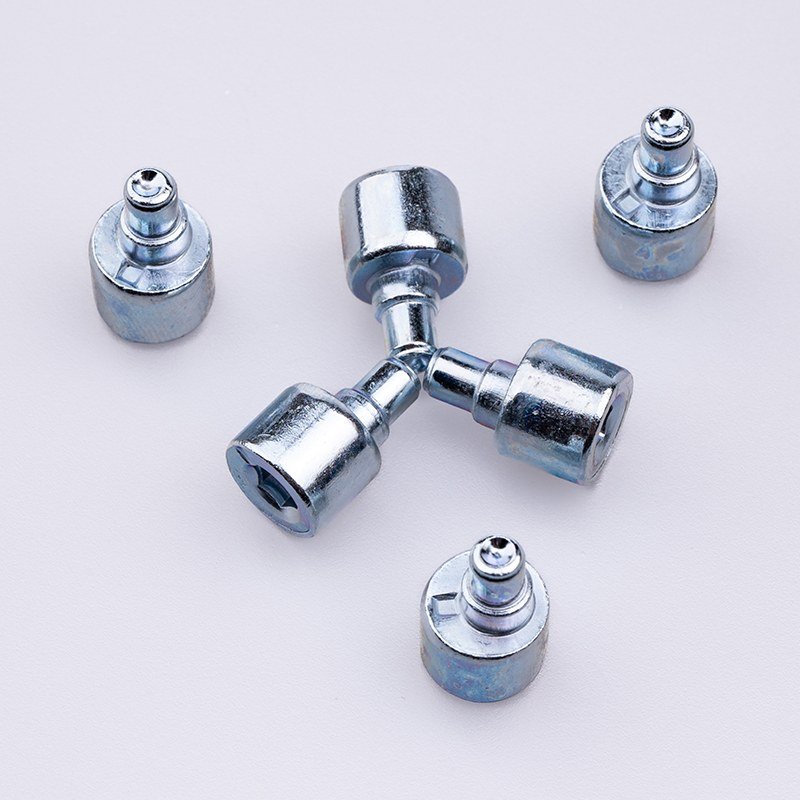
Cam-and-bolt connectors are the parts that hold a flat-pack cabinet together, and they are also the parts buyers most often get wrong on a first order. A connecting bolt that is a millimetre too long stands proud of the panel; a cam that does not match the bolt head slips instead of drawing the joint tight; a barrel whose thread pitch is off will not bite. We quote this family constantly — minifix-style bolts, two-in-one and three-in-one connectors, octagonal dowels with steel sleeves — and the requotes almost always trace back to a few dimensions left off the RFQ. This is what a factory needs to make furniture connecting hardware right the first time, built around real orders we have handled.
Real inquiries from this family
These came from very different markets, and each one turns on a feature a casual request leaves out:
- An Indonesian buyer specified a minifix connecting bolt at 4 × 32.5 mm — a short, slender shank where length tolerance decides whether the head seats flush.
- A Korean buyer needed a reverse-hook (undercut) connecting bolt at M6 × 35 mm, where the undercut geometry, not the thread, is the functional feature.
- A Taiwanese buyer ordered a connector paired with a cam at M6 × 45 mm plus a 15 × 12 mm cam — the bolt head and cam housing have to be matched as a set.
- A US buyer wanted a two-in-one connecting bolt at 34 × 11 mm, and a separate US order for a concealed quick-fit connector sized to 5/8″ and 3/4″ panel material.
- Buyers in Ukraine, Bahrain, Morocco and Tanzania asked for octagonal connecting dowels with steel sleeves and two-in-one / three-in-one sets in the M6 range.
One family, at least eight countries — and every one of these was quoted from our own production, not bought in.
Why cam-and-bolt hardware rejects at assembly
The complaints we hear about connectors from a previous supplier fall into a short, preventable list:
- Shank length off nominal. The bolt is sized to the panel thickness and the cam bore depth. A shank a millimetre long leaves the head proud; a millimetre short and the cam never reaches the head to draw the joint.
- Head and cam mismatch. The cam grips a specific head diameter and neck. Pair a bolt head with the wrong cam and the cam spins without pulling the panels together.
- Thread or undercut inconsistency. A barrel nut or dowel with a loose pitch strips; an undercut hook that varies in depth will not latch reliably.
- Sleeve fit. On octagonal dowels with a steel sleeve, an interference that is too tight splits the dowel and too loose rattles free.
How we make and verify furniture connectors
Which process fits depends on the part’s size, features, and batch, so we match the part to the equipment rather than force everything down one route:
- Forming. Bolts and dowels in common diameters are cold-headed (wire φ2.0–15.8 mm), which is where the M6 shanks in these orders sit. Small batches, undercuts, and cam housings that do not justify a die are turned on our Swiss-type lathes (up to φ25 mm) and turn-mill equipment (φ2–200 mm).
- Threading. Threads are rolled on equipment covering M4–M12 at lengths up to 200 mm, which spans the whole connecting-bolt range here.
- Cam and eccentric features. The offset that lets a cam draw a joint tight is the same discipline behind our eccentric parts — verified on a concentricity tester covering φ3–25 mm workpieces.
- Dimensions. Length and diameter are read on an optical profile projector (0–300 mm range, ±0.0005 precision), and full lots pass an automatic optical sorting machine that reads outer diameter and length to within 0.01 mm on every piece.
- Finish. Where a visible head or a smooth shank matters, surface finish is measured on a roughness tester before plating.
What your RFQ should include
If you buy connecting bolts, cam locks, or dowel connectors — or are moving an existing part to a new supplier — these are the lines that let a factory quote accurately without a second round of questions:
- Panel thickness and joint type. State the material thickness (for example 5/8″ or 3/4″) so the shank length and cam depth are matched to your panel, not guessed.
- Bolt diameter, shank length, and thread, with tolerances — the length tolerance matters more than the nominal.
- Cam size and the head it grips, if a cam is used, so the set is matched. A cam is not a generic part.
- Any undercut, hook, or sleeve — position, depth, and fit. On a reverse-hook or sleeved dowel this is the functional dimension.
- Material and finish — steel with zinc plating for most furniture, or stainless where corrosion matters.
- A drawing, or a sample. If no drawing exists, send the part or the mating panel: we reverse the specification and return it for your approval before quoting.
Where this sits in our range
Furniture connectors are core to what we form, turn, and inspect. You can see the range on our mini-fix connectors page and across our furniture screws category. The related discipline shows up in neighbouring pieces: the cam and offset side in eccentric screws for glass door hinges, the small-batch turned side in stainless male-female insert nuts, and the outdoor-grade material side in stainless furniture screws.
Send your connector drawing for a quotation, or the panel it has to join if the drawing never existed — either way you will get back a specification you can hold every future shipment against.