



Stainless Male-Female Insert Nuts for Marble Dining Tables: Why Small Batches Are CNC-Turned

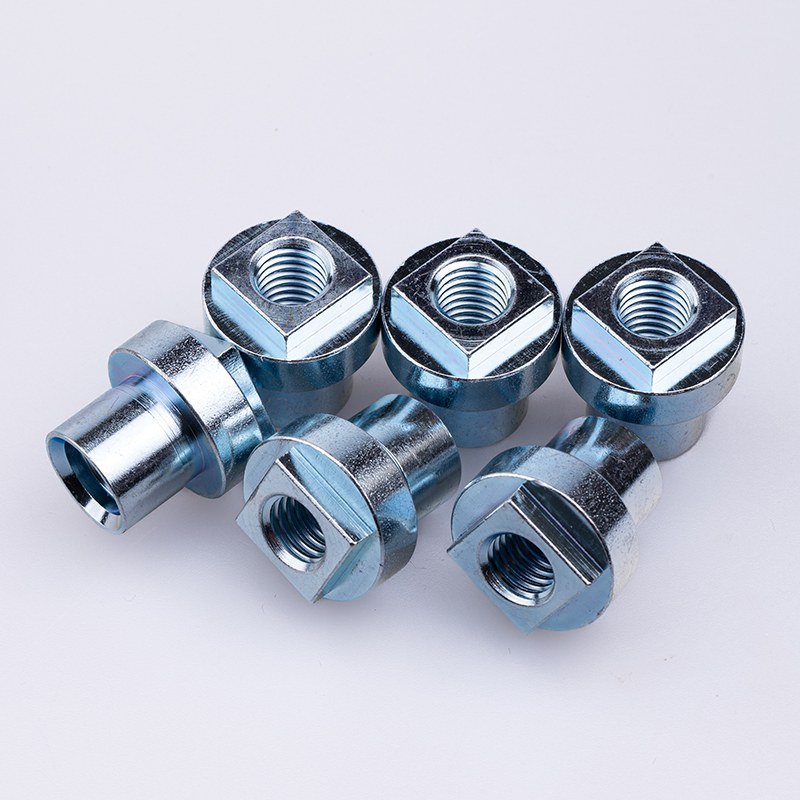
On a premium marble dining table, the legs and top are joined by a small stainless fastener most buyers never see: a male-female insert nut (also called a male-female standoff, or 内外牙 in Chinese factories). One end carries an external thread, the other an internal one. It is a simple part — and a surprisingly common source of rust stains, slow assembly, and wobbly tables when it is specified as a commodity.
Two problems we kept hearing about
A furniture hardware customer supplying high-end marble dining tables came to us with two recurring complaints about their existing male-female fasteners:
- Rust. The parts were made from plain iron/carbon steel. In a dining environment — moisture, cleaning agents, years of service — they corroded, and the stains showed on expensive furniture.
- Slow driving and loosening. The thread crest and root were cut flat. A flat crest makes the part slow to lead in and drive during assembly; a flat root leaves the joint prone to working loose after repeated use.
What we changed
The improved part we produce for this application makes two changes:
- Stainless steel instead of iron. Corrosion resistance suited to furniture that is wiped down for years, and a service life to match the marble it supports.
- A sharpened thread crest and a rounded root. The pointed crest leads into the mating part faster during assembly; the rounded root profile resists loosening once seated.
In this program, the redesigned insert improved the customer’s assembly efficiency by more than 10%, and the assembled joints stayed tight — the standard fitting on their premium marble dining tables. A typical part in this family is a slotted stainless male-female insert, M6×16; inquiries in this family also commonly ask for M8×20, M12 and similar sizes.
Why small-batch stainless male-female parts are CNC-turned, not cold-headed
This is the question behind most quotations in this product family, so we answer it openly.
Cold heading is the economical process for fasteners — once a dedicated die set is made and the volume justifies it. For a male-female part in stainless steel at small batch sizes, tooling up a cold-heading die usually does not make commercial sense.
CNC turning needs no dedicated die. The part is machined directly from stainless bar stock, which is exactly right for small batches, frequent size changes (M6×16 today, M8×20 next order), and the sharper thread-profile details this design calls for. The trade-off is honest: the unit price of a turned part is higher than a cold-headed one. If your volumes later grow to the point where cold heading pays for its tooling, the same drawing can move to that process — that decision is a calculation, not a guess, and we will show you where the crossover sits.
If you are comparing quotes and one supplier is far cheaper on small-batch stainless male-female parts, ask which process they are quoting and how they are forming the internal thread — the price difference usually lives there.
How the threads are verified
Both threads on a male-female part have to gauge correctly or assembly suffers at the customer’s line:
- Internal threads are checked with GO / NO-GO plug gauges (metric 6H/7H).
- External threads are checked with GO / NO-GO ring gauges.
- Thread form and overall geometry are confirmed on an optical profile projector (0–300 mm range).
Specifying a male-female insert
For an accurate quotation, the details that matter most: both thread sizes and their engagement lengths, overall length, the drive feature (slotted, hex socket, or external hex), material grade, expected batch size — this decides the turning-vs-cold-heading question above — and the mating materials (stone, wood, metal frame). This part family sits alongside our insert nuts and our broader CNC turned parts capability, where thread verification works the same way.
Send your drawing for a quotation, or a sample if no drawing exists — we will reverse the spec and tell you honestly which process fits your volume.