


Eccentric Locking Pins: What to Specify Before You Ask for a Price

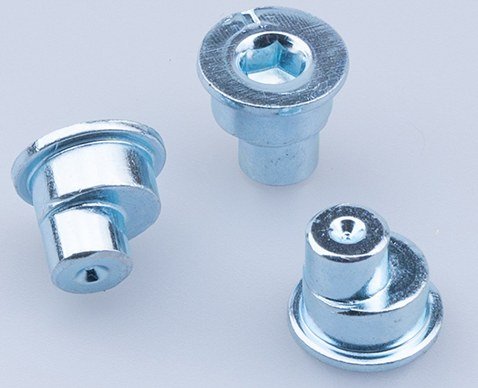
An eccentric locking pin looks deceptively simple: a short pin whose head or shoulder sits off-axis from its shank. That offset is the whole point — turned in place, it pulls or locks the mating parts together. It is also the reason this part punishes vague purchasing specs harder than an ordinary dowel or straight pin ever will.
A real inquiry from this family
A Turkish buyer came to us with an eccentric locking pin — described on their side as an eccentric step pin — at φ10.2 × 15.5 mm, with a stated annual usage around 15 million pieces. At that volume, nothing about the spec is a detail. A drawing ambiguity that costs a few rejected parts in a small batch becomes a container-level problem at millions of pieces per year, so the quotation conversation is really a specification conversation.
Why the offset changes how the part must be verified
A symmetric part can be formed by the closed-die process that suits ball-head studs; an eccentric geometry cannot — the offset rules that route out, and it equally rules out casual inspection. Checking an eccentric pin against a print means checking the offset itself, not just diameters and lengths:
- Concentricity and offset measurement. We run eccentric parts on a concentricity tester covering φ3–25 mm workpieces — it reads eccentricity, bend, and end-face runout directly, and a φ10.2 pin sits comfortably in that range.
- Dedicated eccentric gauges. For an eccentric rivet program in hinge fittings, we build custom gauges that simulate the actual assembly, backed by 2D vision measurement; that program holds concentricity within 5°, which is what keeps the assembled fitting snug instead of rattling.
- Profile and dimensions. Thread and contour geometry are confirmed on an optical profile projector (0–300 mm range, ±0.0005 precision).
What your RFQ should specify
If you buy eccentric locking pins — or are moving an existing part to a new supplier — these are the items that let a factory quote accurately the first time:
- Basic envelope: shank diameter and overall length (our Turkish example: φ10.2 × 15.5 mm).
- The offset callout: how far off-axis, measured from where, with what tolerance. This single dimension drives tooling, inspection method, and price more than any other line on the drawing.
- Material, hardness, finish: if the pin is hardened, state the requirement — we verify on Vickers (HV100–800) and Rockwell (HRC20–70) scales. If it is plated, corrosion performance is confirmed by salt-spray testing to a no-white-rust, no-black-rust, no-red-rust criterion.
- Batch size and annual volume: tooling and gauging are program-level investments; volume decides how they are amortised and quoted.
- A drawing — or a sample. If no drawing exists, send the part: we reverse the specification, including the offset, and return it for your approval before quoting.
Where this part sits in our range
Eccentric locking pins belong to the same family as our eccentric screws, where the same offset-verification discipline applies — we have written about how that plays out in glass door hinge fittings. On the pin side, the adjacent precision problem is covered in our piece on precision hinge pins.
Send your eccentric pin drawing for a quotation — or the physical part, if the drawing never existed. Either way, you will get back a spec you can hold every future shipment against.