



Eccentric Screws for Glass Door Hinges: Controlling the Geometry That Keeps Doors Tight

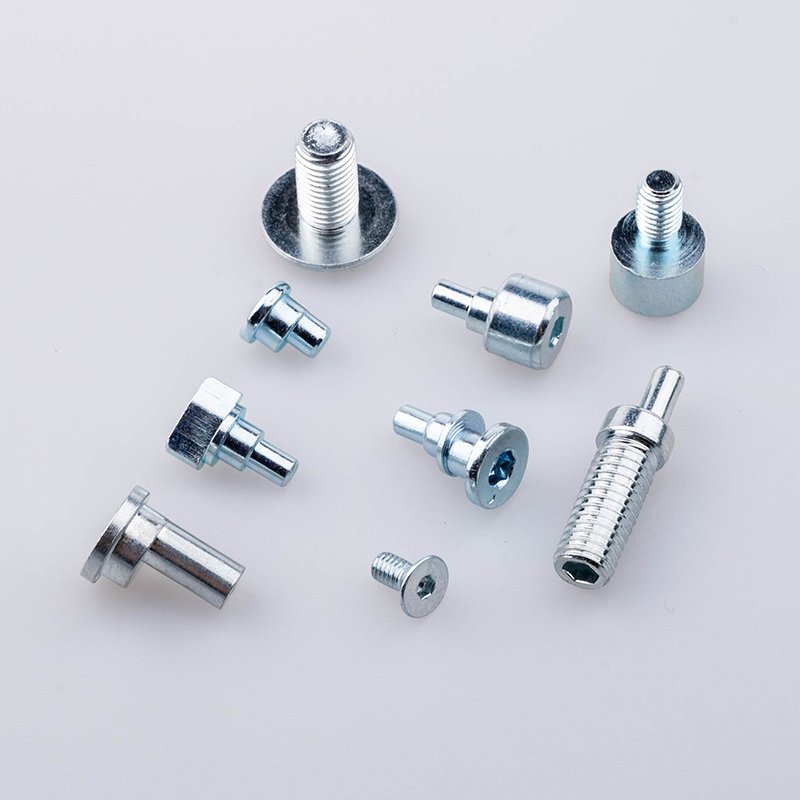
A heavy glass door opens and closes hundreds of times a day. The part that quietly decides whether its hinge stays tight — or works loose into a safety problem — is often the smallest one in the assembly: the eccentric screw or eccentric rivet inside the hinge fitting.
Where eccentric fasteners fail
An eccentric screw has a deliberate offset between its axes — turning it shifts the position of the part it holds, which is what lets installers fine-adjust a hinge. That same geometry makes it unforgiving to manufacture. The three defects customers most often bring to us from previous suppliers:
- Excessive concentricity deviation between the offset features — the fastener simply will not seat in the hinge, or seats with stress that shows up later as loosening.
- Incompletely formed threads — the joint feels tight at installation but is not fully engaged, and repeated door cycles work it loose.
- Out-of-spec hex dimensions — drivers slip or bind, and assembly-line efficiency drops.
How we control the geometry
At Guangdong Taiyuanfeng (TYF), eccentric screws and rivets are produced with the inspection built around the customer’s actual assembly, not just the drawing:
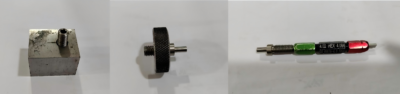
- Custom eccentric gauges + 2D vision measurement. For each eccentric part we build a dedicated checking fixture that simulates how the part installs in the hinge, then verify on a 2D vision measuring system. Alignment deviation is held within 5°, so the part mates flush in the fitting.
- Fully formed threads, verified so the joint closes without gaps.
- Hex go/no-go bar check on every batch, so the drive size is right on every piece, not just the sampled ones.
- A dedicated concentricity tester (workpiece range Φ3–25 mm) backs this up for offset and runout checks.
The result in the field
After we took over one glass-door hinge program with exactly the three defects above, the installed doors stayed tight — the customer has reported zero complaints since switching, and order volumes have grown. Eccentric rivets are a small line item on a hinge BOM, but they are the part that determines whether the door is still solid a year later.
Specifying eccentric screws
To get an accurate quotation, the three things to include with your drawing or sample: the offset dimension and its tolerance, how the part is driven (hex size if applicable), and the mating fitting — ideally the hinge itself or its drawing, so we can build the assembly-simulating gauge from day one. Eccentric screws are also widely used in furniture and mechanical assemblies where a built-in fine adjustment is needed.
Send your drawing for a quotation, or a sample if no drawing exists — we will reverse the spec.