



Plating High-Strength Bolts: Hydrogen Embrittlement and What to Write on the Drawing

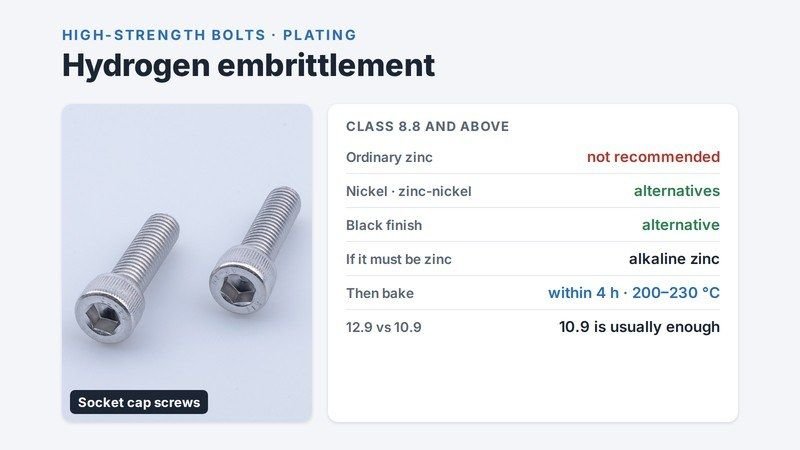
Short answer: Electroplating puts hydrogen into steel, and in high-strength bolts that hydrogen can cause delayed fracture: the bolt breaks hours or days after it was tightened, with no warning. From property class 8.8 up, ordinary zinc plating is not recommended. Choose another finish, such as nickel, zinc-nickel or a black finish, or, if it has to be zinc, specify alkaline zinc followed by a baking treatment within 4 hours of plating. Do not ask for 12.9 where 10.9 will do.
What hydrogen embrittlement is
During plating, hydrogen forms at the surface of the part and some of it diffuses into the steel. In soft steel it does little harm. In hardened steel under tension, it collects at points of high stress and cracks start from there. The bolt passes inspection, goes into the assembly, is tightened, and fails later. That delay is what makes it dangerous: nothing at goods-in will show it.
The risk rises with strength. For carbon-steel bolts of class 8.8 and above, ordinary zinc plating should be avoided. From 10.9 upward, plating a high-strength part is the classic combination for delayed fracture, and a baking step after plating is essential.
The options
- Choose a different finish. For classes from 8.8 up, nickel, zinc-nickel or a black finish are the usual alternatives to ordinary zinc.
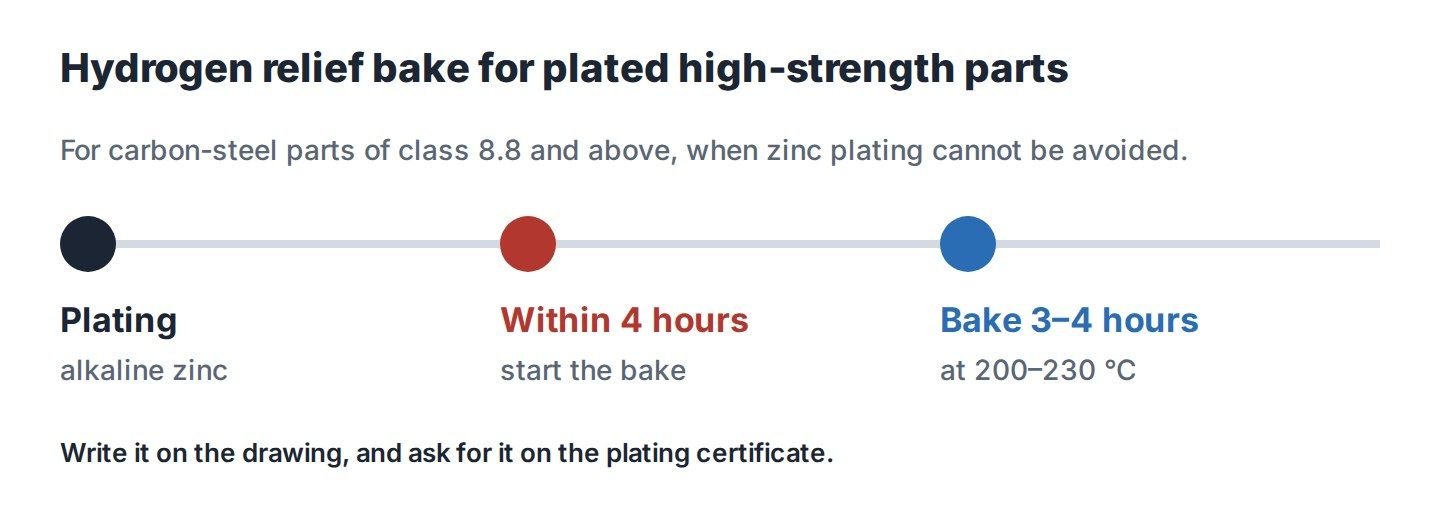
- If it must be zinc, specify alkaline zinc and a hydrogen relief bake: within 4 hours of plating, at 200–230 °C for 3–4 hours.
- Do not over-specify strength. 12.9 costs noticeably more than 10.9 and carries a higher embrittlement risk. In most applications 10.9 is enough. Ask whether the joint really needs the higher class before you write it on the drawing.
What to write on the drawing
- The property class, as low as the joint allows.
- The finish in full: for example “zinc-nickel” or “alkaline zinc, Cr3+ passivation”, not just “zinc plated”.
- The bake, if the part is plated: “hydrogen embrittlement relief: bake within 4 h of plating, 200–230 °C, 3–4 h”.
- Proof on the paperwork. Ask for the bake to be recorded on the plating certificate.
Our plating is done by plating partners, so for parts that need baking, the bake has to be written on the plating order itself. Whoever supplies your parts, ask to see it on the certificate.
If you are specifying plated high-strength fasteners, send the drawing through our RFQ form. We will tell you which finish and treatment we would put on the plating order before we quote.
Related: black zinc or black oxide on hinge screws · custom fasteners made to your drawing
How this was written: the finish rules and baking parameters come from our engineering FAQ; the risk ranking by strength class follows published guidance on hydrogen embrittlement of fasteners.