


Black Zinc or Black Oxide on Hinge Screws: What Each Finish Actually Gives You

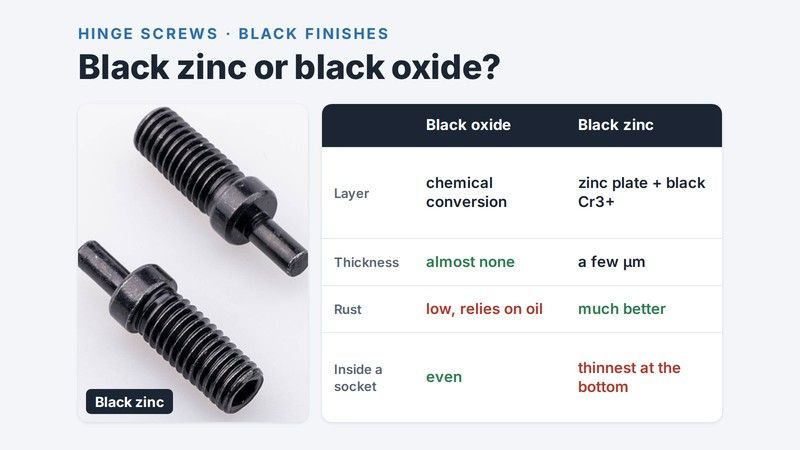
Short answer: Black oxide is a chemical conversion layer: it colours the steel evenly, including the inside of a hex socket, adds almost no thickness, and relies on oil for what little corrosion protection it has. Black zinc is an electroplated zinc layer with a black passivation on top: it protects much better, but like any electroplate it struggles to reach the bottom of a deep recess. For a black hinge that has to look black and also resist rust, black zinc is usually the right choice, provided the drawing says how the inside of the socket will be judged.
A real choice between the two
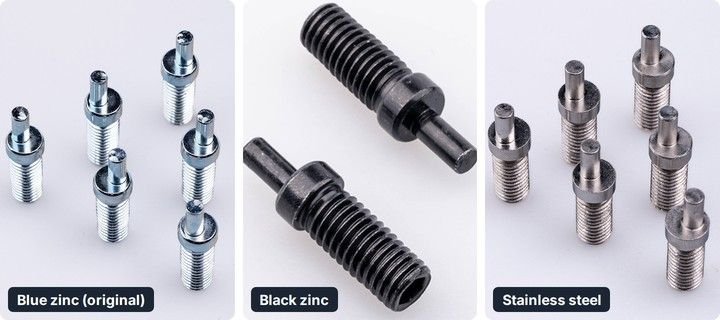
In 2024 a door and window hinge customer asked for one of their eccentric shoulder screws in black, for a black version of their hinges. We sent samples in both finishes: black zinc with trivalent passivation, and black oxide. They chose black zinc: on a black hinge the screw is partly decorative, but it still has to resist corrosion.
Their feedback also flagged a problem with the black zinc samples: a few pieces had no coating at the bottom of the hex socket. For this customer that was two problems at once. Bare steel inside the socket rusts first, and on a black hinge a bright spot in the socket shows. They asked for more thorough control of the coating.
Our factory committed to paying closer attention to the sockets, and we told the customer how far we could control the defect before the order went ahead. The black zinc screw has been ordered again since.
What each finish is
- Black oxide is formed by a chemical bath that converts the steel surface into a thin black oxide. It adds almost no thickness, so threads and fits are unchanged, and because it is a reaction with the surface, it reaches every place the liquid touches, including deep sockets. On its own it gives very little protection; the parts are oiled afterwards, and the oil does most of the work.
- Black zinc is zinc electroplated onto the steel, followed by a black passivation, today normally trivalent (Cr3+). The zinc protects the steel sacrificially, so the part resists rust far better than black oxide. The plating adds a few microns of thickness, which matters on tight threads and fits, and the electric current that deposits it is weakest in deep recesses.
In many workshops “blackening” means black oxide, while buyers often use it for any black finish. On a drawing or a purchase order, the two words describe different parts.
Why the bottom of a hex socket stays bare
In barrel plating, thousands of parts tumble in the bath while current flows through them. Current concentrates on edges and outer surfaces and falls off inside cavities. A hex socket is a small, deep, blind cavity, so its bottom receives the least current, and solution or air trapped in it can block the deposit altogether. On blue zinc a thin spot is hard to see. On black zinc it shows as a bright patch, which is why the customer’s inspection caught it.
Our plating is done by a plating partner, so the controls sit in two places: how the plater loads and runs the parts, and what we check when a plated lot comes back. What the customer can control is the drawing: saying whether the inside of the socket is judged, and how.
What to write on the drawing
- Name the finish in full. “Zinc plated, black trivalent (Cr3+) passivation” or “black oxide, oiled”. “Black” or “blackened” alone can come back as either.
- Say whether the socket counts. For example: “coating must cover the bottom of the hex socket; checked visually” or “socket interior not inspected”. Without a note, the supplier and the customer may judge the same part differently.
- State the corrosion requirement you need, as a neutral salt spray test and a result, if it matters for the product. We confirm what can be met for the specific part and finish before we quote.
- Check fits after plating. If the screw goes into a tight thread or a mating part, ask for gauging after plating, not before.
If you are changing a screw from a bright finish to black, send the drawing and the finish you have in mind through our RFQ form. We will send samples in the options that fit, as we did here, so the choice is made on real parts.
Related: eccentric shoulder screws: holding the 90° socket angle · custom fasteners made to your drawing
How this was written: the case comes from our email records with the customer (2024). The customer is not named. Finish descriptions are general plating practice.