



Inside a Concealed Hinge: The Small Parts That Do the Adjusting

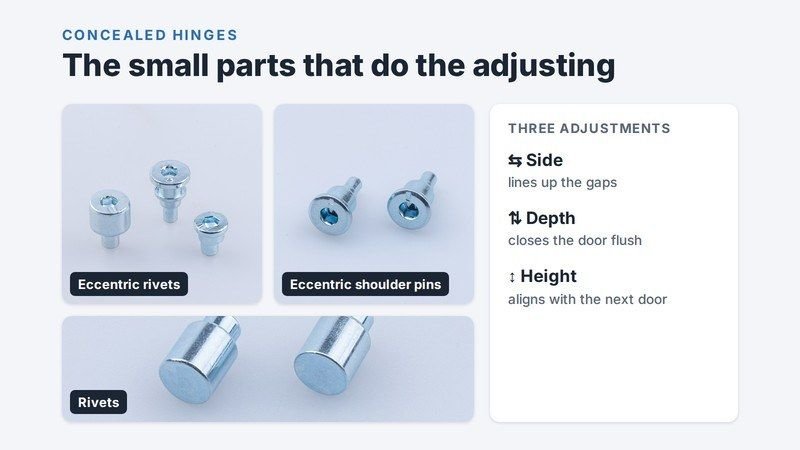
Short answer: A European-style concealed hinge is set with three adjusting screws: one for depth, one for the side (overlay) and one for height. Around them sit the small turned and headed parts that make the adjustment work and keep it: eccentric parts that turn a screw into a small sideways movement, rivets and pins that hold the hinge arms together, and the screws that fix the mounting plate to the cabinet. Most complaints about a hinge in use trace back to one of these parts, or to the holes they sit in.
The three adjustments
- Side (overlay). Moves the door left or right so the gaps between doors line up.
- Depth. Moves the door towards or away from the cabinet so it closes flush.
- Height. Moves the door up or down so it lines up with the next one.
How each one is built varies by brand and model. On many hinges at least one adjustment runs through an eccentric: a part with an offset that converts a turn of the screwdriver into a small, controlled shift. The offset sets the range of adjustment, and the fit of the eccentric in its hole decides whether the setting holds after months of daily use.
The small parts and what each one does
- Adjusting screws carry the three adjustments. They need to turn smoothly but not move by themselves.
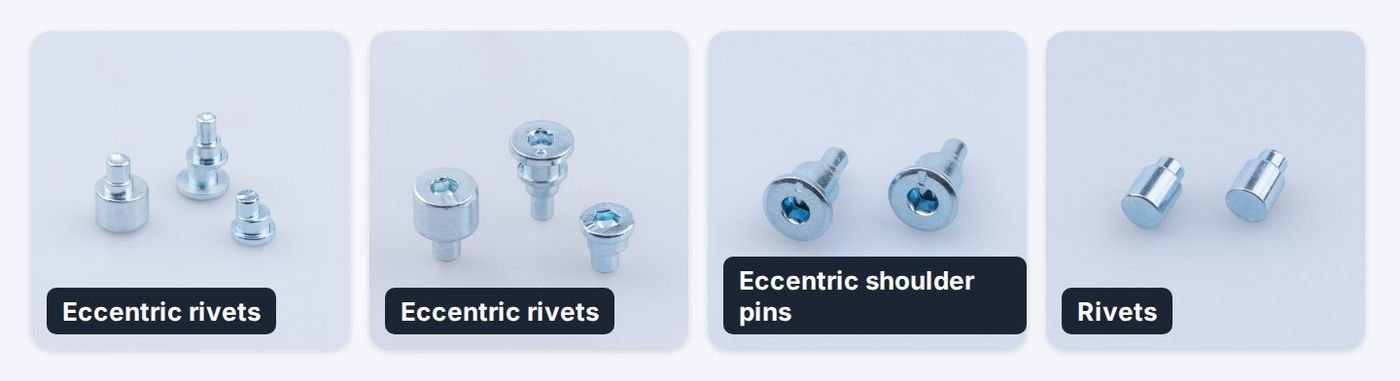
- Eccentric rivets and eccentric shoulder pins give the offset for an adjustment. Their offset and diameters have to match the hinge arm closely, or the adjustment feels loose.
- Rivets and hinge pins are the pivots of the hinge arms. A loose rivet shows up as play or noise in the door.
- Mounting screws fix the plate to the cabinet side: chipboard screws, or euro screws with expanding dowels.
What installers run into
Two problems come up again and again in woodworking forums. The first is the mounting plate working loose. One cabinetmaker described doors in heavy use where the hinge screws had stripped the holes in the face frame where the mounting plate sits, even though the hinges themselves were fine.
The second is setting out. A furniture maker on a Polish forum gave the rule of thumb: the centre of the hinge cup hole about 21.5 mm from the door edge, and 37 mm from the front edge of the cabinet side to the mounting plate. A cup hole at 20 or 23 mm will still work, but it eats into the adjustment range. He also warned against mixing hinge models or brands on one door, because they move slightly differently.
Both points matter to hinge makers too. The adjustment range is only as useful as the setting-out allows, and a hinge that holds its adjustment depends on parts that are consistent from one lot to the next.
For hinge makers
We make eccentric rivets, eccentric shoulder pins and screws, and rivets for hinge makers, to their drawings. If you are sourcing small parts for a hinge, send the drawings through our RFQ form, with the hinge part they go into if you can. We will tell you which dimensions decide the fit, and how we check them.
Related: eccentric shoulder screws: holding the 90° socket angle · cold-heading defects on a shoulder screw
How this was written: the hinge construction comes from public hinge catalogues; the installer quotes come from public woodworking forums, linked above. Product photos are our own parts.