


How Many Blows Does a Cold-Headed Part Need? Upset Ratio, Cut-Off and Cold Shuts

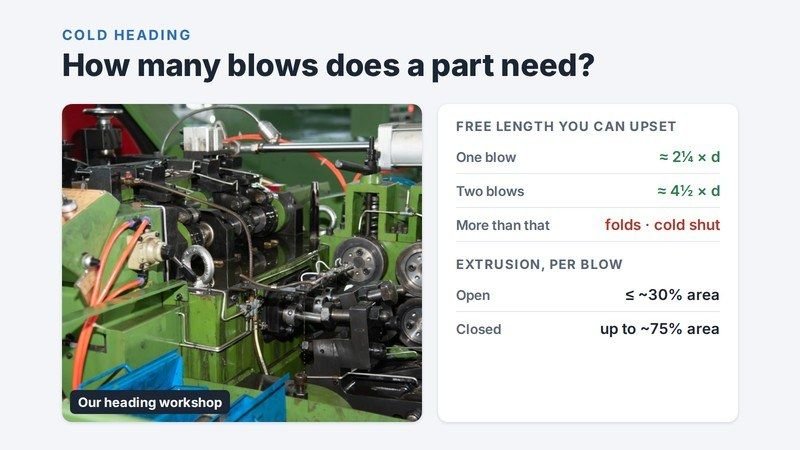
Short answer: How many blows a cold-headed part needs is decided mostly by the head. In one blow, the wire that stands out of the die can be upset to a length of about 2¼ times its diameter; in two blows, about 4½ times. Push past that and the wire bends and folds over on itself, leaving a cold shut: a hidden lap that can crack later. Big heads on thin shanks therefore need more blows, more stations or a thicker wire with the shank extruded down, and that is what sets the tooling and the price.
The upset ratio
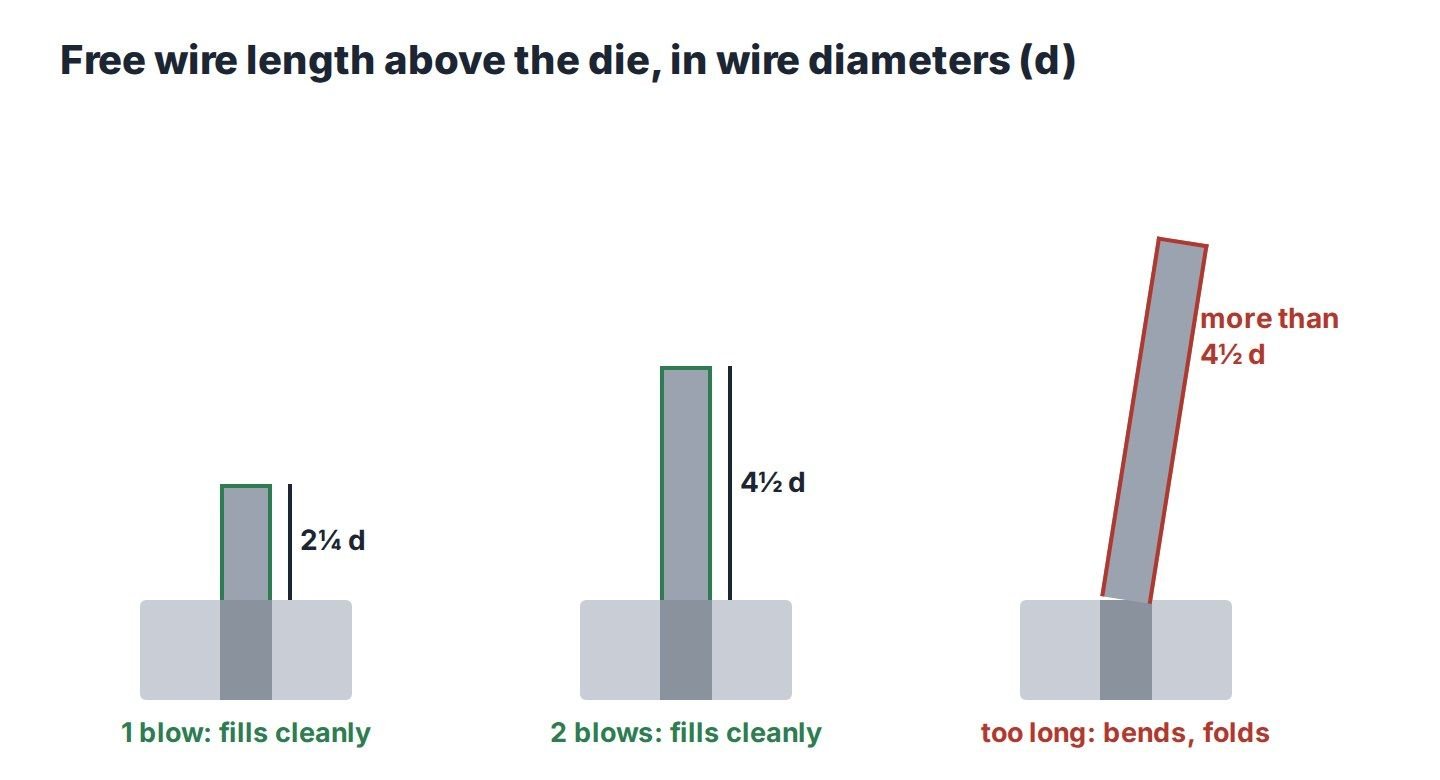
When a header forms a head, a length of wire stands out of the die and is squeezed down into the head shape. A short, stubby length upsets cleanly. A long, thin length behaves like a column under load: it buckles before it fills. As a rule of thumb, one blow can upset about 2¼ wire diameters of free length, and two blows about 4½. A head that needs more metal than that has to be made another way: start from a thicker wire and extrude the shank down to size, or spread the forming over more stations.
A cold shut is the defect that shows the rule was broken. The metal folds over and the fold closes up, so the surface can look acceptable while a crack sits under it. On a load-bearing part, that is the starting point for a failure.
Cut-off volume: where size stability starts
Cold heading does not remove metal; it moves it. The volume of the cut blank is the volume of the finished part. Cut too much and the head comes out oversize or heavy; cut too little and the die does not fill. So when head size or part weight drifts within a lot, the first thing to check is the cut-off: tool wear, wire slipping in the feed, or clearance in the guide. Our own inspection standard for a hinge shoulder screw traces uneven shoulder fill to exactly this, a blank cut too short.
Extrusion is measured in area
When a shank is extruded thinner, the reduction that matters is the cross-section area, not the diameter. Taking a diameter from 1.00 to 0.87 looks small, but the area drops by about 25%. In open extrusion, about 30% reduction per blow is the practical limit; in closed extrusion, up to about 75%. Parts with several diameters on one shank, like stepped rivets, are most economical by forward extrusion; cup shapes such as nuts and semi-tubular rivets are made by backward extrusion.
Why a headed part is stronger at the neck
In a headed part, the grain of the metal follows the outline of the head and turns the corner into the shank unbroken. In a part turned from bar, the grain is cut straight across under the head. The head-to-shank fillet is where a bolt or pin is loaded hardest, so a headed part is stronger and more fatigue-resistant there. It is also why machining a load-bearing part afterwards to “correct” a dimension under the head is a bad trade.
What this means for your drawing
- A large head on a thin shank costs more blows or more stations. If the head volume can come down, ask; it may change the machine and the price.
- Several shank diameters are fine for heading, but each reduction has a limit per blow.
- Tight head dimensions depend on a stable cut-off. Ask how the supplier controls it.
- Keep load-bearing fillets as formed. Ask for heading, not turning, where the part carries load.
If you want to know how many blows and stations your part will need, send the drawing through our RFQ form. We will tell you how we would form it, and whether a small change to the head would make it simpler.
Related: cold-heading defects on a shoulder screw · custom fasteners made to your drawing
How this was written: the ratios and limits are rules of thumb from cold-heading industry references (Carpenter, Heading Hints) used in our engineering training. The shoulder-fill example comes from our own inspection standard.