



Mixed Sizes in a Rivet Shipment: The Five Places It Gets In

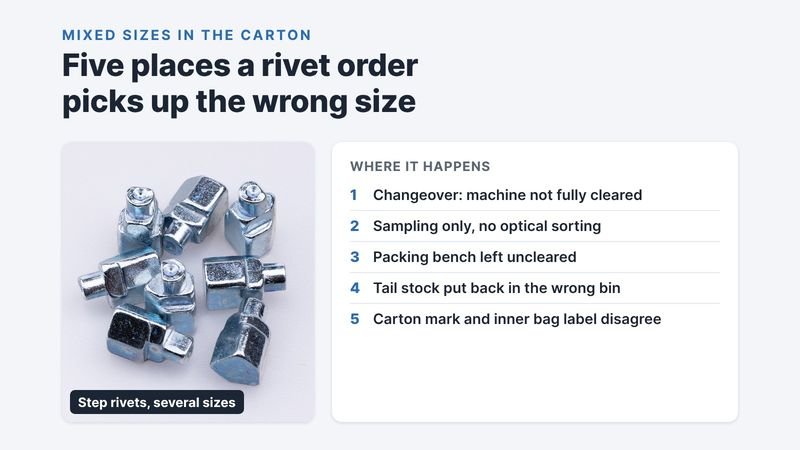
Short answer: When a carton of rivets contains a few pieces of the wrong size, the cause is almost never the forming machine making a wrong part. It is one of five handling points: an incomplete machine clear-down at changeover, sampling without optical sorting, a packing bench that was not cleared, tail stock returned to the wrong bin, or a carton mark that disagrees with the inner bag label. Each point has a control that closes it, and each is checkable on your side as well as ours. Two of them you can see in the photographs below: the optical sorting and counting stations are equipment we have. The rest are procedural requirements, and which of them apply to your order is worth putting in the order rather than assuming.

1. Changeover without a full clear-down
Rivets of neighbouring sizes run on the same machine, often one after the other. Pieces left in the feed bowl, the chute or the catch tray carry over into the next run. The control that closes it is a clear-down between sizes: bowl emptied, chute blown out, tray removed and checked, and the first pieces of the new run set aside rather than dropped into the same box. Where two sizes look alike, the schedule should also keep them off the same machine back to back.
2. Sampling instead of sorting
Sampling is designed to estimate a rate, not to find a handful of outliers in a bulk pack. If ten wrong pieces are spread through a carton, a sample will usually miss them, and the paperwork will say the lot is fine. Where mixing is the risk the customer actually cares about, the answer is optical sorting on the full quantity rather than a bigger sample: the sorter separates by profile and length and does not get tired. We treat that as a specified operation to be agreed and quoted, not as something that silently happens to every order.

3. A packing bench that was not cleared
This is the quietest of the five. A bench that still holds a tray, a scoop or a half bag from the previous size will mix sizes at the last possible moment, after every upstream check has passed. The control is procedural and cheap: one size on the bench at a time, the bench cleared between jobs, and scoops kept with their own bins rather than shared. A counting scale does not catch this, because the count still comes out right — which is exactly why it is worth naming separately.
4. Tail stock returned to the wrong bin
The remainder at the end of a run is the single most likely piece of stock to end up labelled wrong. It gets bagged quickly, often by whoever is finishing the shift, and put back on a shelf next to visually identical neighbours. Months later it is drawn for a new order and the mixing is already inside the bin. The control is to bag and label tail stock at the machine, before it leaves the station, and to put returned stock back through identification rather than straight onto the shelf.

5. Carton mark and inner bag label that disagree
Strictly this one does not mix the pieces, it mislabels them, and from the receiving side the two are indistinguishable. It happens when the outer label is printed from the order and the inner label from the production record, or when a carton is re-made and the old mark is not removed. The control is to generate both labels from the same record and to read them against each other when the carton is closed. It is also the first thing worth checking when a complaint arrives, because it decides whether the problem is handling or paperwork.
What to ask for when mixing is a real risk for you
- Say so at the RFQ stage. Optical sorting of the full quantity is a quoted operation; added after the fact it means unpacking and re-running the order.
- Ask which sizes run on the same machine in the same week, and whether neighbouring sizes are scheduled back to back.
- Ask for the inner label and the carton mark to be generated from the same record, and keep one of each when you open a carton.
- Agree how a mixed-size finding will be handled before it happens: pieces kept, photographed with the labels, and which lot the pieces are traced to.
- If you sort on arrival, tell us the result either way. A lot that came through clean is as useful to us as one that did not.
Rivets are also the parts where the assembly method decides how much a mixed piece actually costs you downstream; we covered that in solid rivets for orbital riveting. Where sizes are close enough that sorting by eye is not realistic, say so on the drawing and we will treat it as a sorting requirement rather than an inspection one.
To put sorting and labelling requirements into a quote, send the part details through our RFQ form and say which sizes you run side by side on your own line.
Related: rivets ordered non-magnetic, arrived magnetic · pre-shipment inspection
How this was written: the five points are from our own internal FAQ entry on outgoing control gaps for rivets, reviewed in July 2026. The parts and the workshop photos are our own. No customer, industry or country is named, and no inspection rate is claimed.