



Low-Head Socket Cap Screws: When the Standard and the Drawing Disagree on a Tolerance

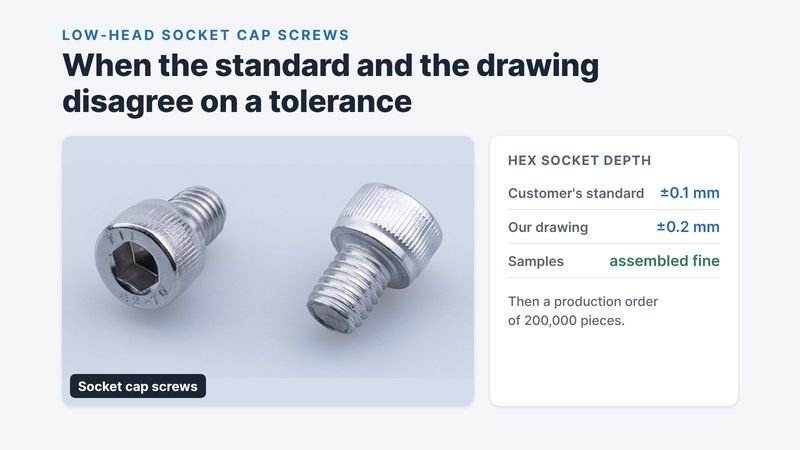
Short answer: When the customer’s standard and the supplier’s drawing give different tolerances for the same feature, test it in the real assembly before arguing over the drawing. On this low-head socket cap screw, the customer’s standard gave the hex socket depth ±0.1 mm, and our drawing said ±0.2 mm. Samples went to the customer to assemble, they worked, and the production order followed.
The case: a low-head screw for a building-systems maker
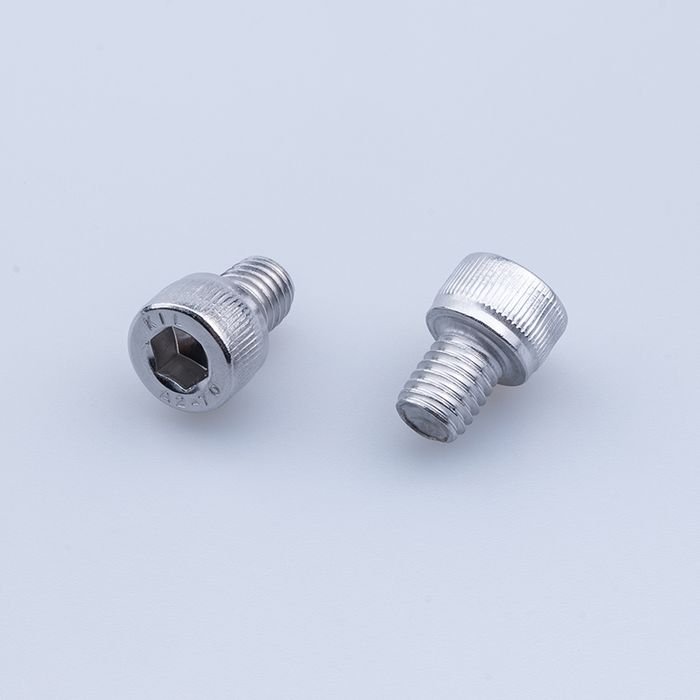
A maker of metal building systems sent an inquiry with the drawing, the hardness and the delivery address, and pointed out that the head was lower than a standard socket cap screw. The part was an M4 low-head socket cap screw in property class 8.8, zinc plated.
The customer worked to DIN 7168 general tolerances, the older DIN standard that ISO 2768 replaced. Under it, the hex socket depth carried ±0.1 mm. Our drawing gave ±0.2 mm.
Why socket depth matters on a low head
A lower head leaves less material under the hex socket. The socket has to be deep enough for the key to drive the screw, and the head still has to be strong enough not to crack or strip. On a low head, the depth tolerance sits between those two limits.
How it was settled
Instead of arguing over the number, we suggested making samples first and sending them to the customer to assemble. The samples assembled without problems, and the customer approved them.
The commercial side was settled along the way. The tooling charge stayed, but the order was arranged so that a 200,000-piece run could go by sea instead of air, which brought the freight down. The customer paid the tooling, approved the samples, and placed a production order for 200,000 pieces.
When a tolerance in your standard and the drawing disagree
- Say which standard and tolerance class your drawing follows, such as ISO 2768-m.
- Mark the features where the tolerance really matters for your assembly.
- If the supplier’s drawing differs, ask for samples to test in the real assembly.
- Agree the final tolerance in writing before production.
If you need low-head or other special socket screws, send the drawing and the standard you work to through our RFQ form. We will flag any tolerance we read differently before we quote.
Related: what a European hardware drawing asks for beyond the dimensions · custom fasteners made to your drawing
How this was written: the case comes from our sales records and order history (2025–2026). The tolerances are the ones on the customer’s standard and our drawing. The customer is not named.