
Before You Approve a Fastener Quote: Six Terms to Check
Drive, strength class, head, stainless grade, double thread and plating: six lines where a supplier's quote most often mistranslates an RFQ, and what each should read.
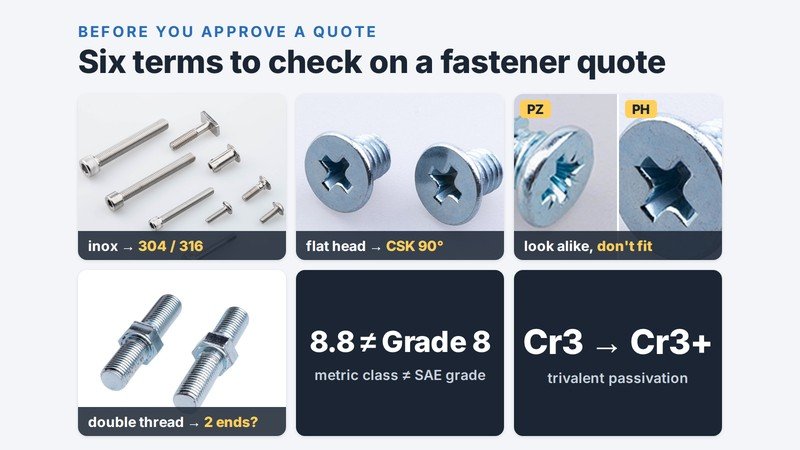
Short answer: A supplier's quote and revised drawing are a translation of your RFQ, and six terms are where that translation most often goes wrong: the drive, the strength class, the head, the stainless grade, "double thread" and the plating. Before you approve a quote or a sample, check that each of these comes back written exactly the way you meant it. We know this list well because it is the list our own sales team trains on; we have seen each of these go wrong, including in our own order records.
1. Drive: PZ2 must not come back as PH2 or "cross"
Phillips (PH) and Pozidriv (PZ) recesses look alike at a glance. Pozidriv has four extra lines between the arms of the cross, and the recess walls are shaped differently. The two are not interchangeable: a PH bit in a PZ recess cams out and damages it, and the reverse is just as bad. A quote that says "cross recess" or "PH2" against a PZ2 drawing means your assembly bits will not fit the parts.
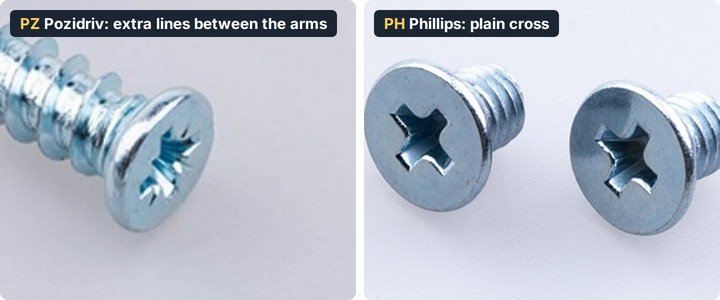
Check: the drive type and size on the quote match the drawing exactly, "PZ2" or "PH2", and never "cross" on its own.
2. Strength: 8.8 must not come back as "Grade 8"
Metric bolts use property classes from ISO 898-1: 8.8, 10.9, 12.9. Imperial bolts use SAE J429 grades: Grade 5, Grade 8. The numbers look alike, but they do not match. A class 8.8 bolt has a nominal tensile strength of 800 MPa, while SAE Grade 8 is specified at 150,000 psi, about 1,030 MPa. The closest imperial match to 8.8 is Grade 5 (120,000 psi); Grade 8 sits near class 10.9. A quote that turns 8.8 into "Grade 8" is quoting a different bolt.
Check: the quote says "property class 8.8" for metric parts, or "SAE J429 Grade 5" or "Grade 8" for imperial parts, and the class matches your drawing.
3. Head: "flat head" can mean two different heads
In American usage a flat head screw is a countersunk screw: the head is conical underneath and sits flush with the surface. Many European engineers read "flat head" as a low head with a flat underside that sits on top of the surface. If you asked for countersunk screws and the quote says "flat head", the supplier may mean the same thing you do, or not.
Check: the quote says "countersunk (CSK)" with the head angle, usually 90°. If it says "flat head", ask which one.
4. Stainless: "inox" must come back with a grade
Buyers in Italy and Poland often write inox on an inquiry. The word means stainless steel in general, and the grades differ a lot in price and corrosion resistance: 201 costs least, 304 is the everyday grade, and 316 is chosen for salt and chlorides. A quote that repeats "inox" or "stainless" without a grade leaves the choice to the supplier, and nothing on the quote tells you which grade you will get.
Check: the quote names the grade, for example "304 (A2)" or "316 (A4)". When we receive "inox" alone, we ask which grade before we quote.
5. "Double thread": two ends or two starts?
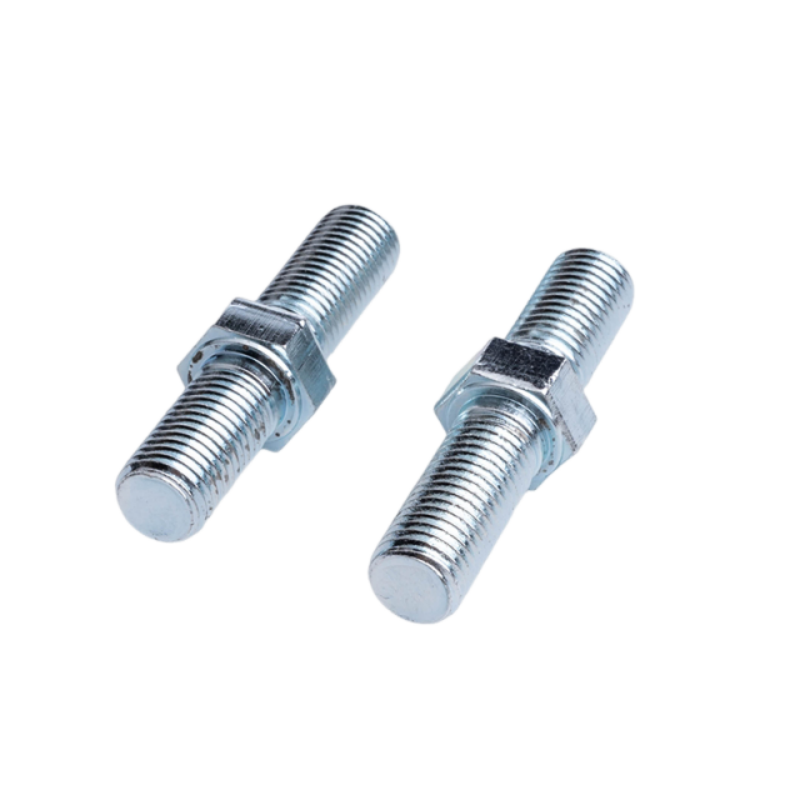
"Double thread" is used for two different parts. One is threaded at both ends, such as a hanger bolt with a wood thread on one end and a machine thread on the other. The other has a two-start thread: one thread form with two helices, which advances twice as far per turn. They are made differently and priced differently. We have seen the two mixed up in our own order records, so we ask every time.
Check: the quote says "double-ended" or "hanger bolt" for threads at both ends, or "two-start thread, lead = 2 × pitch" for the other.
6. Plating: "Cr3" is not a specification
RoHS-compliant zinc plating uses trivalent chromium passivation, written Cr3+, as opposed to hexavalent (Cr6+). On quotes and packing documents it is sometimes shortened to "Cr3", which can be read as a chromium content or a code, and it says nothing about the zinc underneath.
Check: the quote says "zinc plated, trivalent (Cr3+) passivation", with the colour, and the zinc thickness and salt spray test if those matter to you.
Quick reference
| Item | Can come back as | Should read |
|---|---|---|
| Drive | "cross", or PH instead of PZ | PZ2 or PH2, as on the drawing |
| Strength | "Grade 8" for a metric bolt | class 8.8 (ISO 898-1), or SAE J429 Grade 5/8 |
| Head | "flat head" | countersunk (CSK) 90° |
| Stainless | "inox" or "stainless" | 304 (A2), 316 (A4), etc. |
| Double thread | either meaning | double-ended, or two-start thread |
| Plating | "Cr3" | zinc plated, Cr3+ passivation |
If you have a quote or a drawing in hand and are not sure how one of these lines will be read, send it by email to zoe@tfscrew.com. We will tell you how we read each of these six lines before we quote.
Related: custom fasteners made to your drawing · how to specify pan head Phillips screws
How this was written: the six terms come from our sales team's terminology training notes, built from real inquiries and order records. Strength figures are the nominal values in ISO 898-1 and SAE J429.