



Precision Hinge Pins: Stopping the Squeak and Wobble Before Assembly

On a hinge, the pin is the part that everything else turns on — literally. When a finished hinge squeaks, wobbles, or binds on the assembly line, the cause is often not the leaf or the housing but the small turned pin running through them. Get the pin’s surface and geometry right and the whole fitting feels solid; get it wrong and the defect shows up later as noise, play, or a stuck assembly.
Why hinge pins fail in assembly
A customer came to us with a hinge pin held to an outside-diameter tolerance of +0 / −0.012 mm. Even though the diameter itself measured in spec, their previous parts kept causing problems:
- Unfilled end faces — the two ends of the pin were not cleanly formed, so the pin did not seat squarely.
- Surface depressions and roughness — a rough or pitted surface dragged in the bore, producing the squeak and uneven feel the end customer was complaining about.
- Together these caused hinge noise, rocking, and imbalance after assembly — a quality problem the diameter check alone never caught.
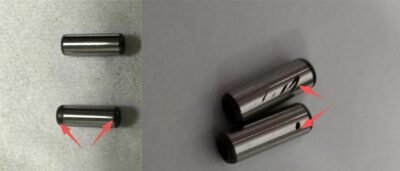
How we control the pin surface and geometry
At Guangdong Taiyuanfeng (TYF), the inspection for a precision pin is built around how it actually runs in the bore, not just its nominal diameter:
- Material prepared for a clean surface. We run 45# carbon steel through two wire-drawing passes before forming, so the starting surface is more uniform and polished.
- Concentricity checked after cold heading, then centerless grinding. Runout is verified on a concentricity tester (workpiece range Φ3–25 mm), and a centerless-grinding step brings the finished surface roughness to within Ra 0.3 μm. We confirm finish on a surface-roughness tester with selectable 0.25 / 0.8 / 2.5 mm sampling lengths.
- Optical sorting on the finished pins. A machine-vision sorter screens every piece for dimensional and surface defects (resolving outside-diameter and length deviations to ≤ 0.01 mm), holding the pass rate above 99.99% rather than relying on sampled inspection.
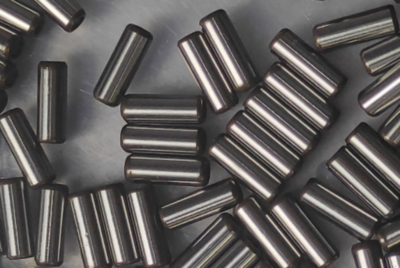
The result in the field
After we took over the program, the pins ran through the customer’s automated assembly without the end-face and surface problems they had been fighting — they reported roughly a 15% reduction in assembly loss, and the finished hinges opened and closed with a noticeably better feel. Precision turned pins are produced on a sliding-head (Swiss-type) lathe for diameters up to 25 mm, which is the range most hinge and fitting pins fall into. The pins in this program are now used by a European hinge manufacturer.
Specifying a precision pin
To get an accurate quotation on a hinge or fitting pin, the details that matter most are: the outside-diameter tolerance, the surface-finish requirement (an Ra target if you have one), the pin length and any end-face or chamfer requirement, and — where the pin runs in a moving joint — the mating bore or the hinge itself, so we can check the part the way it will actually be used. This same precision-pin and turned-component capability supports our eccentric screws and rivets for hinge fittings, where offset geometry and concentricity are controlled the same way.
Send your drawing for a quotation, or a sample if no drawing exists — we will reverse the spec.